


- Investing
- News
Welcome to the latest issue of our quarterly CIO insights.

At a glance
- Geopolitical tensions amplify asymmetric inflation risk, expenses increase with certainty while asset may grow in line with inflation.
- Diversification and discipline underpin resilient, long‑term portfolios.
- Staying invested and avoiding emotional decisions matters more than reacting to headlines.
There is a sobering sense of déjà vu as the reverberations of 2022 resurface in 2026. The current escalation in the Middle East, coupled with the sharp rise in oil prices, is once again jolting markets and triggering familiar reflexes reminiscent of the early days of the Russia–Ukraine conflict.
While I previously signalled the risk of a correction and noted that such corrections are also normal, the scale and nature of the developments in the Middle East were beyond what most could have foreseen.
Like many, I am deeply conscious of the human impact of recent events. Within our own community, we have clients, Partners, and colleagues in the Middle East who have been directly affected, and others with close personal ties to the region. This brings very personal challenges for those affected, and we are deeply mindful of the profound toll they take.
I wrote to our clients shortly after the conflict began, and that message remains unchanged: we are here to support you through this period of uncertainty. Market volatility can feel unsettling at times, but it is a familiar and temporary feature of long-term investing. Your financial plan is designed with this in mind, and we remain available to talk things through whenever helpful.
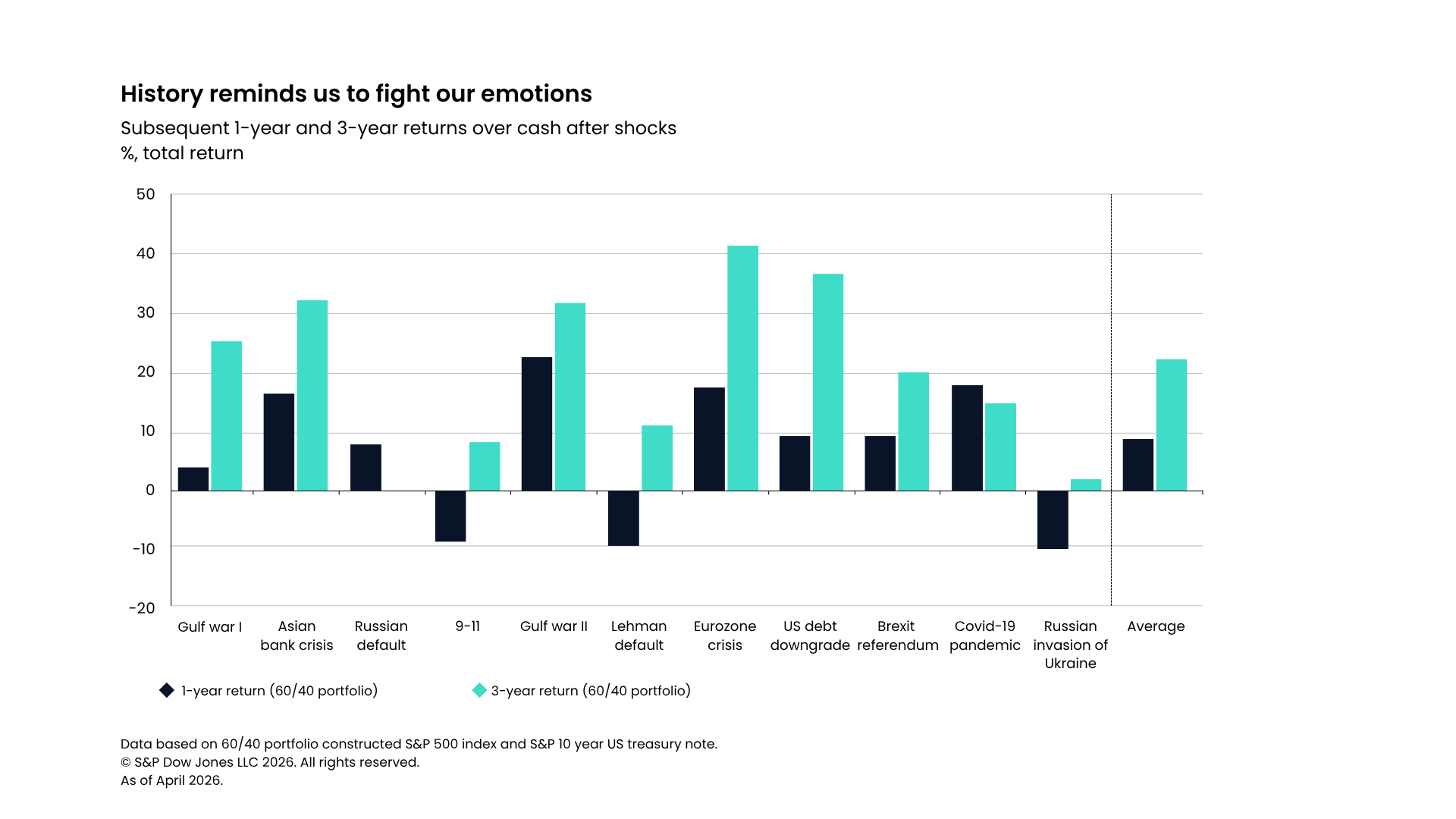
Moments of heightened uncertainty can test investor emotions. While no two periods are ever the same, the chart above shows how, following major geopolitical shocks, markets have often recovered over time and portfolios generally outperform cash, often by a meaningful amount—underscoring the importance of maintaining perspective.
The impact of war and inflation
The decision by the US and Israel to go to war with Iran at the end of February has injected substantial geopolitical turmoil into global markets, drawing in broader international involvement and a heightened sense of uncertainty. Amid the noise, it is worth reiterating that periods like this call for perspective rather than prediction, and reflection rather than reaction.
Markets continue to navigate elevated uncertainty as the situation evolves. With the Strait of Hormuz effectively blocked (at the time of writing), energy markets have become the focal point of investor concerns, having experienced one of the sharpest shocks in history. Inflation and cost of living pressures have once again moved to the forefront of headlines.
While the immediate conflict understandably commands attention, the more durable risk is borne not just by markets, but in the inflationary consequences that are ultimately passed through to consumers. A sustained disruption to global energy supply has the potential to push inflation higher in the near term, and history suggests that even when hostilities pause, second‑round effects can persist through energy markets and re‑routed supply chains.
Sustained inflation affects financial decisions in ways that are often less visible than market volatility. When price pressures persist, the impact is felt not only through rising day-to-day expenses but also through the erosion of any cash or fixed deposit holdings when inflation outpaces interest earned.
These dynamics are already playing out. According to the latest S&P Global US Flash PMI report (often seen as one of the key leading indicators for gauging future inflation risks), measures of business activity point to a sharp rise in input costs, driven largely by higher energy prices, alongside clear evidence that companies are passing these increases on through higher selling prices.
The key here is the asymmetry of inflation on our finances.
Rising prices translate into a largely unavoidable increase in day‑to‑day expenses, leaving little scope to opt out. These costs tend to reset higher and are slow to reverse.
Assets, by contrast, respond to inflation with greater variability. Outcomes are uncertain, but many assets can have the ability to protect against inflation. Well-run businesses can often respond to rising costs by adjusting prices, protecting profits and revenues over time. Such assets move alongside inflation rather than simply absorb it.
Over time, this asymmetry can have a meaningful impact on how wealth builds. Inflation is typically more punitive for expenses and cash holdings than for well‑positioned assets. While cash may feel stable in nominal terms, its purchasing power erodes when inflation outpaces returns. In that sense, inflation creates inevitability for spending, but optionality for assets—reinforcing the importance of remaining focused on long‑term positioning rather than reacting to short‑term volatility.
Process and discipline
The key to “beating inflation” is well-positioned assets. Our approach for assets remains grounded in process and discipline, rather than prediction. Prior to this event, in the last quarterly newsletter, we spoke about market declines not being unusual. We may not be able to predict what will cause these—we don’t believe anyone can do so consistently—but being prepared is key. Stressed environments increase the temptation to react or engage in speculation around inherently unpredictable events. However, this is precisely when discipline matters the most.
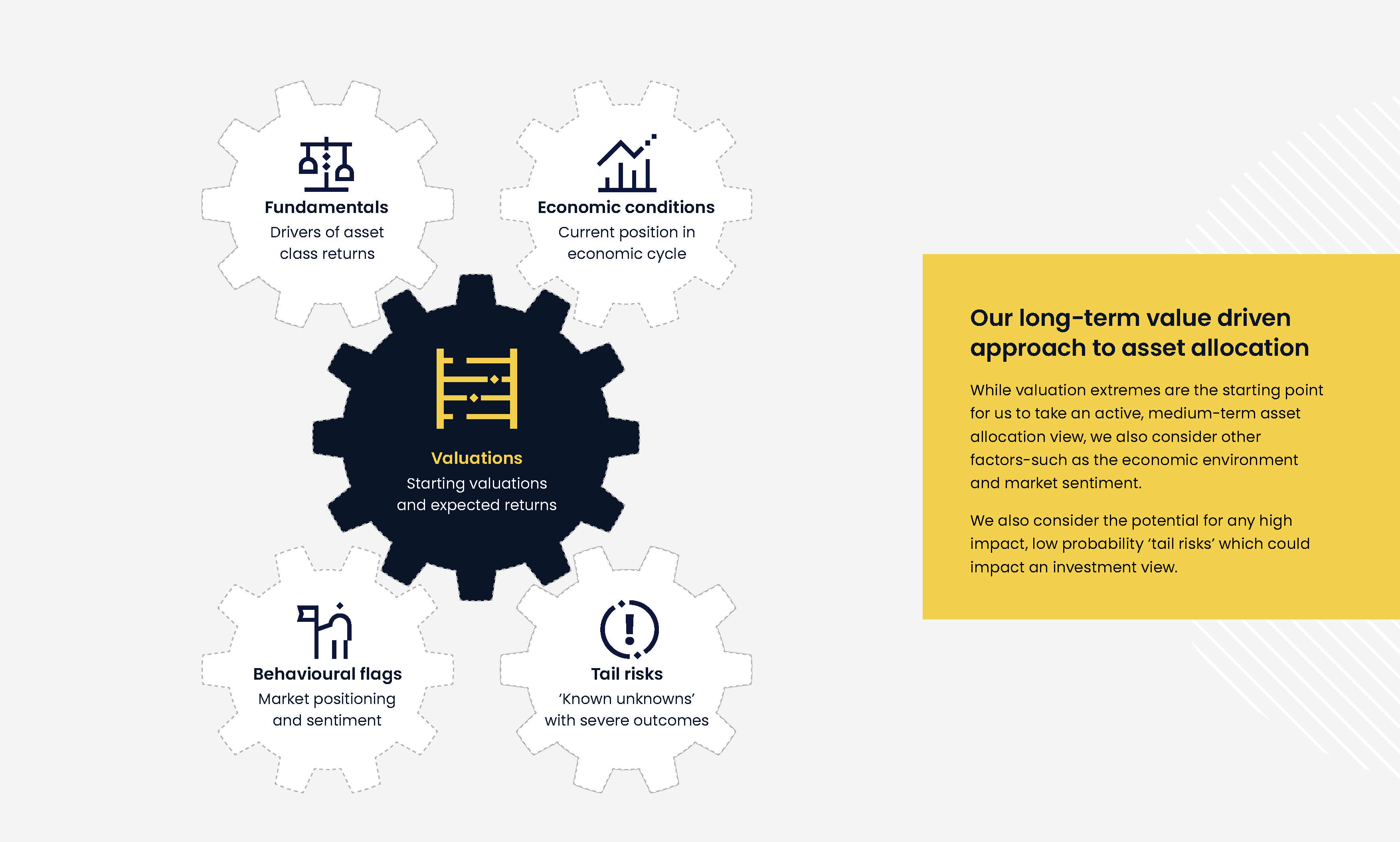
Our asset allocation process begins with valuation gaps (i.e. whether an asset is cheap or expensive), not headlines. Research has repeatedly shown that this is the biggest driver of long-term returns. The areas which are expensive tend to be vulnerable to corrections.
We look to identify where the price of assets seems out of kilter with the underlying fundamentals, whether too high or too low. We then make the decision on our allocation to that particular asset class. The chart below shows the process with the smaller cogs acting as moderators to the valuation view.
A key principle is that we avoid reacting to short-term noise and short-term tactical trading. We know markets can move quickly and sometimes for emotional reasons rather than clear fundamentals. When this happens, it can create opportunities.
Our responsibility is to make sure portfolios are positioned to withstand a range of outcomes, not to guess which path geopolitical actors will take. History shows that under stress, the likelihood of making poor, short-term decisions rise sharply. Investors often mark down risky assets indiscriminately, undervaluing certain markets, and markets can shift multiple times before reaching any meaningful equilibrium. This is why discipline is essential and why staying anchored to long term objectives is far more powerful than attempting to time the market during such volatile periods.
Resilient decisions
Over the past couple of years, we have been taking steps to make our portfolios more resilient to periods like this. That includes spreading investments more widely, adding more defensive assets such as government bonds and inflation-linked bonds, and reducing exposure to riskier lending markets. This preparation means there is less need to make hurried decisions when uncertainty is elevated and pricing is less favourable.
We have underweighted the US market for some time. We made these decisions not because we saw the recent events coming, but because we look for opportunities and manage risks based on valuations. To us, the concentration of the US market on the tech giants posed some risk while undervalued areas, such as Emerging Markets offered better opportunities.
That’s not to say we are completely unimpacted by the global market volatility, nor that we will take no action whatsoever. We are keeping a close eye on the current situation and how it may impact both the risks in our portfolios, as well as the opportunities we see. In particular, we are watching whether higher oil and gas prices persist, whether oil producing countries such as OPEC step in, whether special energy reserves are being drawn down and how investment values settle as markets calm down. We are also reviewing our economic assumptions to reflect recent events. Is a recession more probable now? Where and what will that mean for our asset allocation positioning?
While our overall view has not changed, we are carefully assessing what the current event could mean for inflation and global growth over time.
We know fear rises during complex geopolitical events. From a behavioural perspective, many investors feel a compulsion to act at times of crisis, and this may involve coming out of markets. However, as history shows us, as does the chart below, this is rarely the best decision.
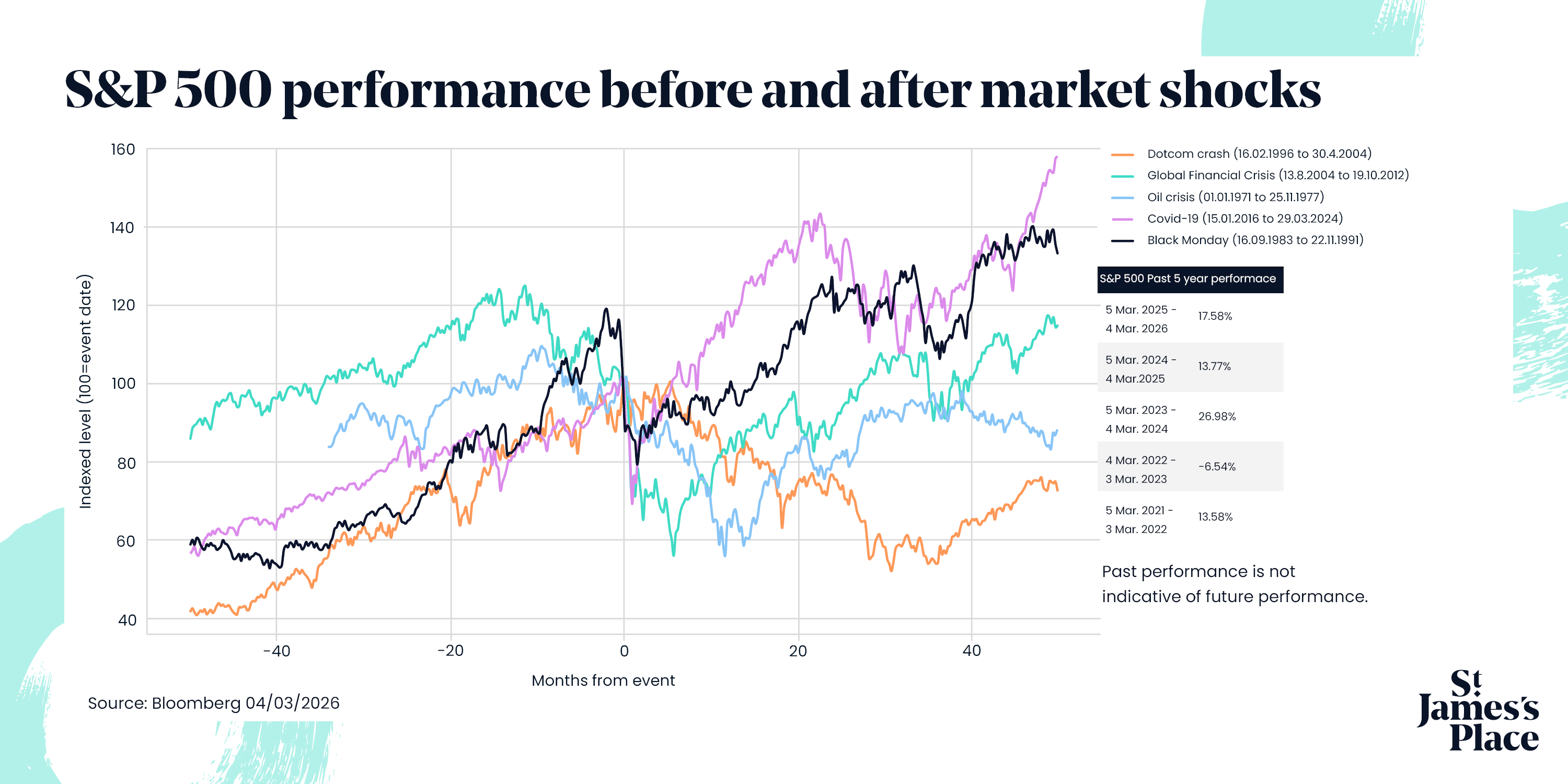
Of course, there is no guarantee that markets will take this path as shown above. Rather, this is what has happened historically.
Conclusion
While headlines may point to the current geopolitical situation as a source of heightened uncertainty and unpredictability, markets have been and are always difficult to forecast with precision. What matters the most for asset allocation is not attempting to predict outcomes, but maintaining a long-term focus and applying discipline with rebalancing where appropriate. This helps to ensure you continue to take the risks you intend to take.
For the investment team here at SJP, we fully own the risk embedded in the portfolios we construct. We took proactive steps when conditions were calmer to build greater resilience and diversification, allowing us to remain measured and disciplined as uncertainty arises. Equally, navigating periods like this requires resilience from all of us—combining thoughtful portfolio management on our side with patience and perspective from clients—so that decisions remain aligned with your long-term goals, and not short-term emotions.
Please note that past performance is not an indicative of future performance, and the value of an investment with St. James’s Place will be directly linked to the performance of the funds selected and may fall as well as rise. You may get back less than the amount invested.
The value of an investment in equities and shares may go up and down. You may get back less than the amount invested. This is different to the capital security typically associated with bank deposits held in cash.
This advertisement has not been reviewed by the Securities and Futures Commission, the Monetary Authority of Singapore, or the Dubai Financial Services Authority. This article is a general communication that is provided for informational purposes only. It should not be relied upon as financial advice, and it does not constitute a recommendation, an offer or solicitation. No responsibility can be accepted for any loss arising from action taken or refrained from based on this publication. All information presented herein is considered to be accurate at the time of production, but no warranty of accuracy is given, and no liability in respect of any error or omission is accepted.

Most popular articles


Most recent articles